
Explore the upstream asset base
Search mining assets by commodity, geography, development status and other available characteristics.
Understand the mining assets behind critical mineral supply and identify the infrastructure, water, jurisdiction and location-based constraints that could affect future production.
Global Mining Dataset gives supply-chain, procurement, strategy and OEM teams a structured view of 25,000+ mining assets across commodities and geographies.Teams can explore the mines and development projects that existing and prospective mineral supply ultimately depends on.
The problem
Critical mineral supply chains ultimately depend on individual mining projects.
Two countries may have similar mineral resources, but the projects expected to develop those resources can face very different infrastructure requirements, water constraints, institutional environments and development conditions.
For supply-chain teams trying to understand future availability, this creates a difficult analytical problem.
Information is typically fragmented across:
Teams then have to connect these sources manually to answer strategic supply questions.
Global Mining Dataset provides a standardised global view of mines, development projects, prospects and other mineral assets.
Each usable asset location can be connected to a common set of above-ground screening metrics.
This gives supply-chain teams a direct view of the physical assets that existing and prospective mineral supply depends on.
Search mining assets by commodity, geography, development status and other available characteristics.
Identify development projects and earlier-stage assets that could form part of the longer-term supply landscape.
Compare infrastructure, water, jurisdiction and surrounding location characteristics across the asset universe.
Enterprise teams can screen private supplier, project or sourcing datasets against the same framework.
National production is the aggregate result of individual mines, expansions and development projects.
Global Mining Dataset allows teams to investigate that underlying asset base for a target commodity.
This creates a more granular starting point for understanding current mining activity and the potential development pipeline.
Development depends on the wider physical and institutional environment surrounding each mining project.
Global Mining Dataset provides a consistent first-pass view of several factors that can shape future mineral supply.
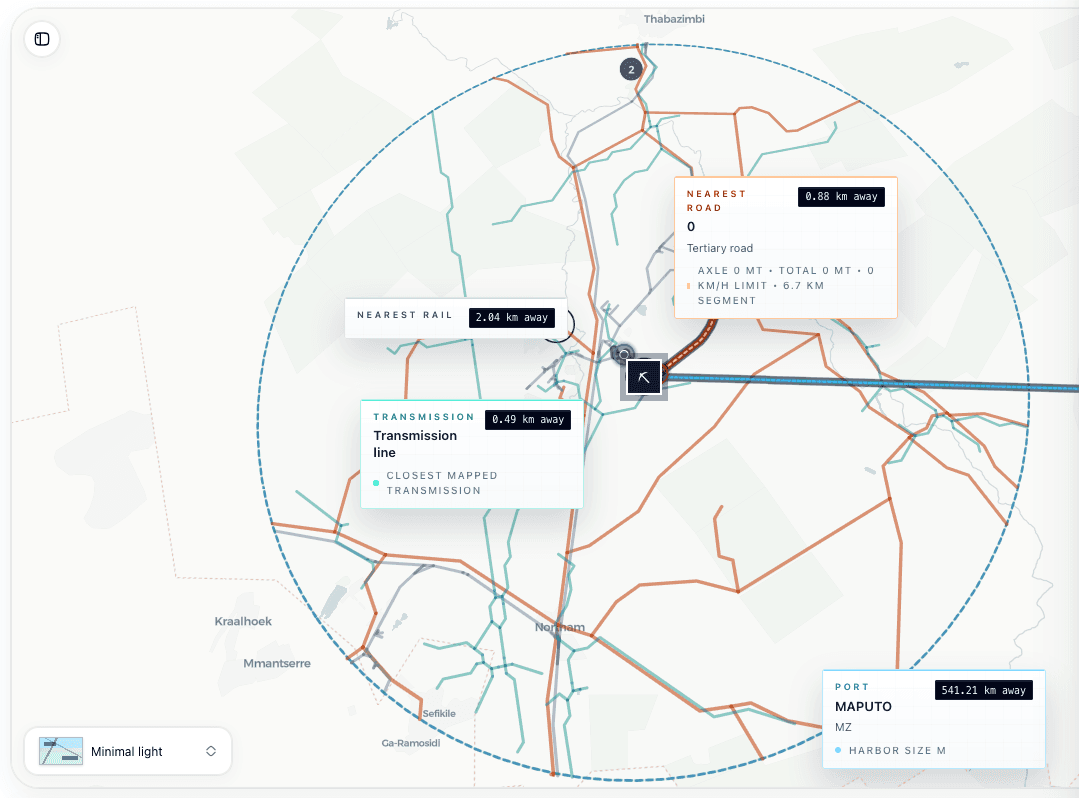
New mineral supply often requires significant supporting infrastructure.
Screen mining assets against surrounding:
Identify projects that may require materially greater supporting development and warrant closer infrastructure analysis.
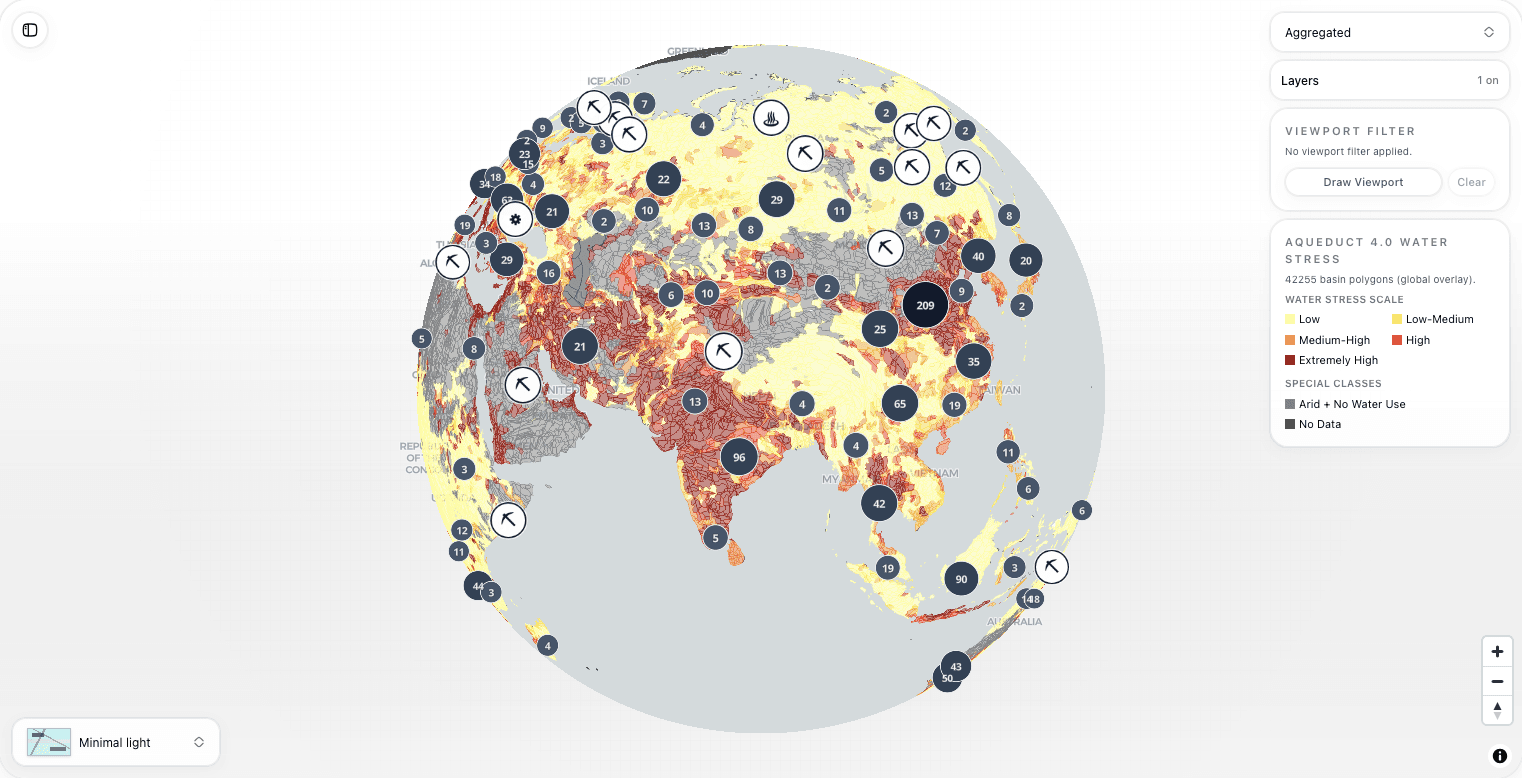
Mining and mineral processing can be highly dependent on access to water.
Compare assets using:
Identify where water may represent a more material consideration for future mineral supply.
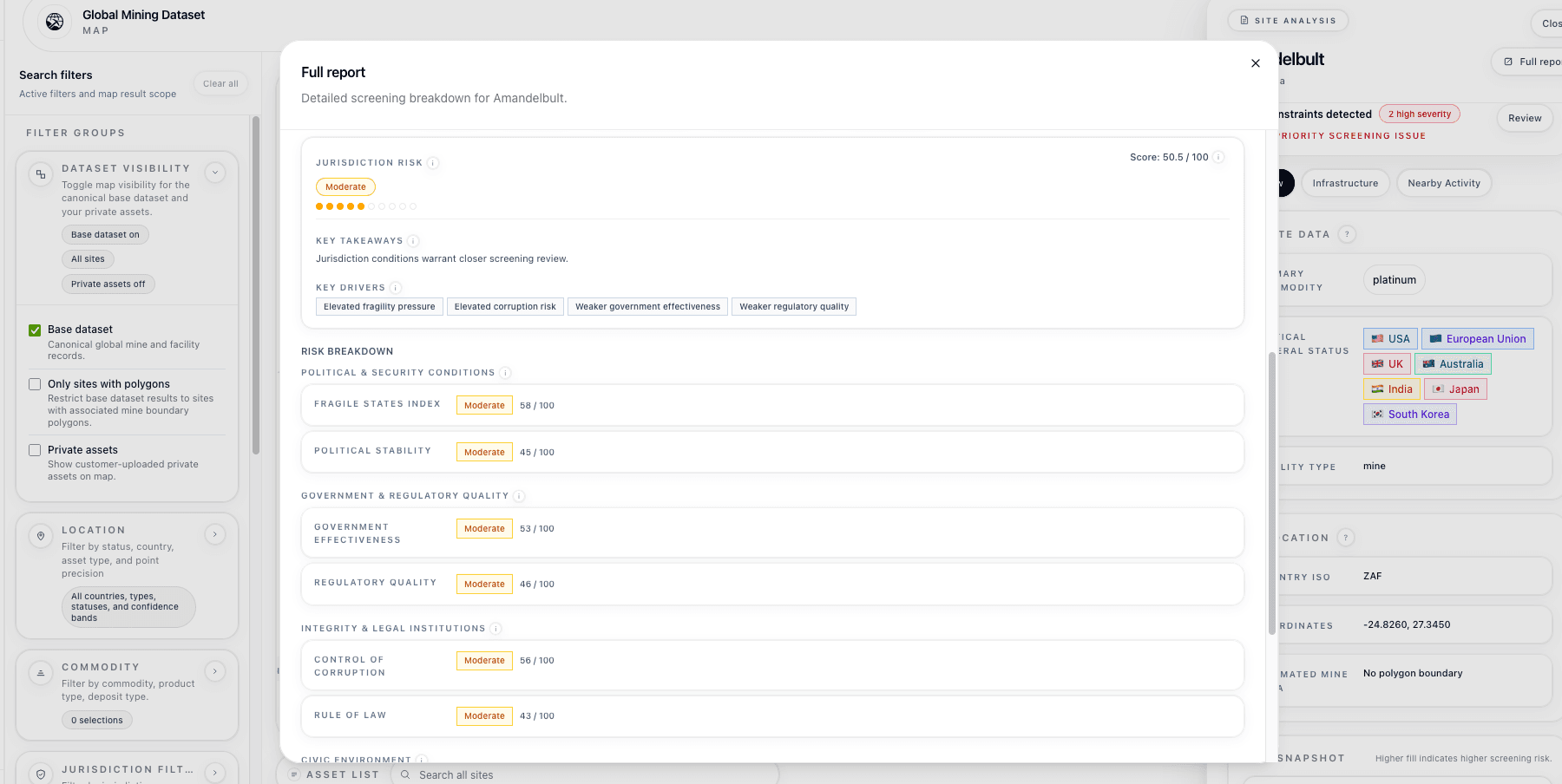
Mineral supply can become concentrated in jurisdictions with very different institutional environments.
Compare mining assets using indicators covering:
Connect jurisdiction exposure directly to the mining projects located in each country.
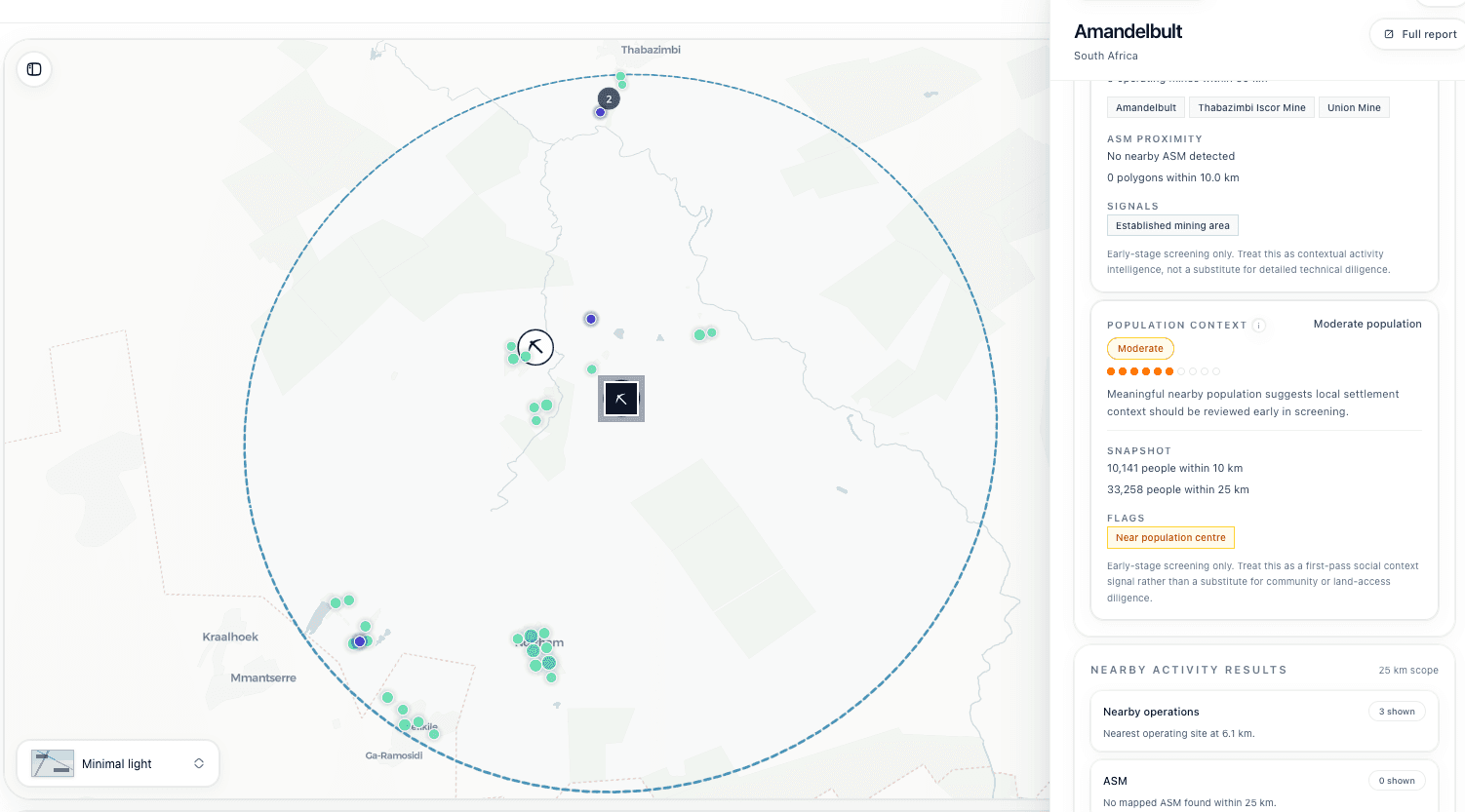
Additional spatial indicators can identify characteristics around individual assets that warrant further investigation.
Depending on available data, these can include:
Surface the asset-level questions that should shape further supply-chain analysis.
Global Mining Dataset supports a more systematic approach to upstream supply-chain analysis.
Step 1
Start with a mineral that is strategically important to your organisation.
This could include copper, lithium, nickel, cobalt, graphite, rare earth elements or another commodity within your supply chain.
Step 2
Identify mines and development projects associated with that commodity across the relevant geographies.
Start from a broad view of the global asset base, including projects beyond those already known to the team.
Step 3
Review where mining activity and development projects are located.
Build a more granular view of geographic exposure than country production statistics provide on their own.
Step 4
Compare assets against common infrastructure, water, jurisdiction and location-based indicators.
Identify where prospective supply may face fundamentally different development environments.
Step 5
Prioritise commodities, jurisdictions and projects that warrant additional market, technical, supplier or commercial analysis.
Step 6
Move structured asset and screening data into internal market models, sourcing analysis, strategy papers and other downstream workflows.
Global Mining Dataset can support questions such as:
Search the wider global asset universe for producing mines, development projects and earlier-stage assets associated with a target commodity.
Understand which countries and regions contain a large share of known projects and compare the underlying assets individually.
Compare road, rail, port, generation and transmission context across mining projects.
Screen project locations against consistent present and future water-stress indicators.
Connect mining assets to governance, stability and fragility indicators to understand where upstream project exposure is concentrated.
Use asset-level screening to reduce a broad global universe to the projects or regions that justify deeper research.
Historical production data explains where supply comes from today. Development projects, prospects and other mineral assets provide a view of where additional supply could emerge.
Global Mining Dataset brings those assets together with producing operations so teams can investigate the wider project pipeline.
Explore lithium, nickel, cobalt or graphite assets and compare development projects across geography, infrastructure and water context.
Examine copper projects across multiple regions to understand where prospective supply is located and which assets face more challenging development conditions.
Compare internal upstream project lists against the same screening framework used across the broader market.
Build a structured view of the assets from which future mineral supply may emerge.
Supply-chain research becomes difficult to compare when commodities, countries and projects are analysed using different sources and assumptions.
Global Mining Dataset applies a common asset structure and screening methodology across the mining asset universe.
The result is a more consistent starting point for strategic supply-chain analysis.
Trade flows, processing capacity and country-level production describe later stages of critical mineral supply chains.
Global Mining Dataset provides visibility into the physical mining assets at the beginning of the chain.
Connecting those assets with infrastructure, water, jurisdiction and other location-based signals helps teams identify where upstream supply warrants closer investigation before it becomes a sourcing problem.
Global Mining Dataset combines mines, development projects, prospects, occurrences and other mining-related assets from multiple underlying sources into a standardised global dataset.
This asset-level intelligence strengthens commodity forecasting, supplier due diligence and supply-chain traceability with consistent evidence about the mining projects beneath each commodity market.
Explore the global mining asset universe and understand the location-based factors that could influence existing and prospective mineral supply.